The Praise of Folly by Erasmus Desiderius Grafton Anthony
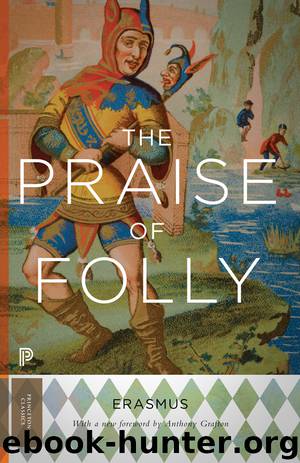
Author:Erasmus, Desiderius, Grafton, Anthony
Language: eng
Format: epub, mobi
Publisher: Princeton University Press
Published: 2015-03-11T04:00:00+00:00
COMMENTARY
Analysis
REFERENCE HAS BEEN MADE, IN THE INTRODUCTORY essay, to the logical and rhetorical structure of The Praise of Folly, The outline or brief below will make clear this structure. The form used is the traditional one drawn from analysis of the classical oration. The main parts, in this form, are the Exordium (designed to win attention and conciliate the audience), the Narration (presenting reasons for speaking or the factual basis of the question, or both), the Partition (dividing the subject and indicating the main topics to be pursued), the Confirmation, or Argument (the main body of the speech), and the Peroration. Sometimes the Proposition, a statement and definition of the subject, was made a separate part, but often it was thought of as belonging with the Partition. The classical form also allowed for one or more digressions, usually in the Confirmation. It will be observed that in Section 31 of the eulogy, when Folly ridicules the preaching of the friars, she goes over this same form of outline as it appears in their sermons.
The brief shows logical relations and order of Ideas. It does not show the great variety of methods used by Erasmus to introduce and to develop these ideas. His transitions are worth special attention. Page-references have been given for the main headings, so that a notion may be gained of the proportion of time spent upon each of the various topics. We find that Erasmus often develops at great length what appears in the brief as a very minor point. One might say that he feels free to dwell upon whatever idea catches his fancy and stimulates his mind. Yet in well organized arguments, such as these are, a contention placed in a most subordinate position is the ultimate support of all placed above it. Thus when Erasmus expends several pages upon what appears in the brief as point XI C 6 h (2), “They [the preaching friars] use farfetched exordia,” he is abundantly proving point h, “Their preaching is absurd,” which in turn supports point 6, “The follies of monks make them happy,” and this is one part of the ground covered by the main point, XI, “All people are followers of Folly.” Incidentally, this eleventh main point, as its inclusive nature warrants, gives rise to the longest treatment of any—about one-fourth of the eulogy. Yet space is not the only criterion of importance. From the moment that Erasmus introduces his criticism of theologians (Section 28) to the beginning of the peroration there is a rising movement—a tightening of grasp and a deepening of essential seriousness. The movement is not unbroken. In order to maintain some consistency with the earlier part—and perhaps by way of “comic relief—Erasmus gives the brief argument that “Fortune favors fools” (Section 34) and indulges in a certain amount of fooling in Section 35. But that the order of climax is well observed, and that the last argument (Sections 38-39), dealing with “Christian folly,” is in the author’s view the most important thing he has to say, one cannot well doubt.
Download
The Praise of Folly by Erasmus Desiderius Grafton Anthony.mobi
This site does not store any files on its server. We only index and link to content provided by other sites. Please contact the content providers to delete copyright contents if any and email us, we'll remove relevant links or contents immediately.
| Anthropology | Archaeology |
| Philosophy | Politics & Government |
| Social Sciences | Sociology |
| Women's Studies |
The remains of the day by Kazuo Ishiguro(9000)
Tools of Titans by Timothy Ferriss(8396)
Giovanni's Room by James Baldwin(7346)
The Black Swan by Nassim Nicholas Taleb(7129)
Inner Engineering: A Yogi's Guide to Joy by Sadhguru(6796)
The Way of Zen by Alan W. Watts(6614)
The Power of Now: A Guide to Spiritual Enlightenment by Eckhart Tolle(5782)
Asking the Right Questions: A Guide to Critical Thinking by M. Neil Browne & Stuart M. Keeley(5775)
The Six Wives Of Henry VIII (WOMEN IN HISTORY) by Fraser Antonia(5515)
Astrophysics for People in a Hurry by Neil DeGrasse Tyson(5190)
Housekeeping by Marilynne Robinson(4448)
12 Rules for Life by Jordan B. Peterson(4305)
Ikigai by Héctor García & Francesc Miralles(4274)
Double Down (Diary of a Wimpy Kid Book 11) by Jeff Kinney(4272)
The Ethical Slut by Janet W. Hardy(4253)
Skin in the Game by Nassim Nicholas Taleb(4250)
The Art of Happiness by The Dalai Lama(4130)
Skin in the Game: Hidden Asymmetries in Daily Life by Nassim Nicholas Taleb(4007)
Walking by Henry David Thoreau(3962)
